
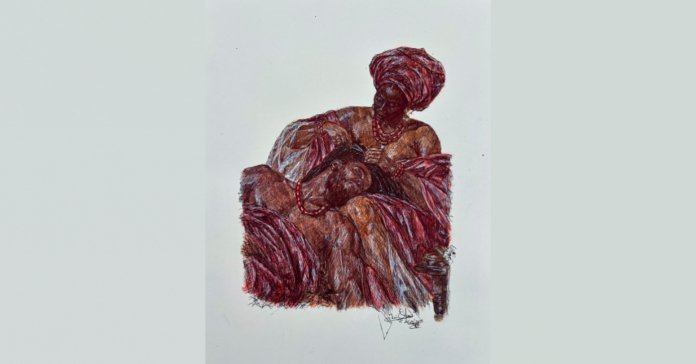
Ini Oluwa has been building a body of work publicly.
The Lagos-based painter, born Inioluwa Aboluwarin, works in ink, acrylic and white charcoal on paper. His current series, Yorùbá Gothic, turns on intimate, domestic scenes: couples, quiet gestures, moments of closeness drawn with a controlled hand. Some compositions echo classical European painting. The feeling, and the world they belong to, remain unmistakably Yorùbá.
Several of the recent pieces have travelled widely on X and Instagram, but the attention is not the point. The consistency is. Ini releases paintings steadily, shows them, prices them and sells them directly. A recognisable language has formed in the process, one that carries its cultural specificity without explaining itself.
None of this is sudden. Ini has been a full-time artist since 2016 and his debut solo show, Fountainhead, ran from 3 to 5 November 2023 at the Hall of Odin in Lekki, Lagos. Some accounts also connect his work to a showing in New York. The visibility around Yorùbá Gothic extends a practice that was already established. The art was already being made. More people have simply begun to see it.
African contemporary art has no shortage of noise. Practices that build a distinct language steadily, on their own authority, are rarer. The paintings do not announce themselves. They accumulate. Holding a standard while they continue to do so.