Most portrait artists ask their subjects to sit still. David Julius, however, waits for them to forget he is there. In restaurants, on beaches, in markets, and on buses, he draws a stranger from a clipboard while the stranger eats lunch, and the stranger is, by design, the last person in the room to know what is happening.
Once the portrait is finished, it is framed, a red rose is added, and the surprise is delivered. Then the camera does what the pencil cannot. It turns to the face of the person receiving it.
The drawing, then the face
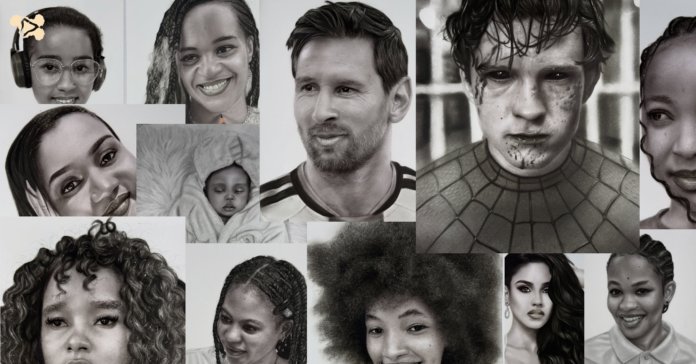
That face is the part worth looking at closely. The work is hyper-realistic, black and white, charcoal and pencil, and self-taught from YouTube. The footage built around it has gathered an audience of roughly 500,000 on Instagram, where he posts as @david_pencil_art, and the reactions carry it: the laughter, the tears, the embrace. The portrait is the proof of skill. The reaction is the proof that skill landed.
Authorship without intermediaries
What David Julius has done, is skip the usual route. Because he makes the work in public and distributes it on his own account, no gallery stands between him and his subject, and no agent stands between him and his audience. Sales then run through a WhatsApp link in his bio.
Moreover, the same clipboard has taken him to a Maasai village in Arusha. It has also taken him onto the stage at a Tanzania Revenue Authority event in Dar es Salaam in May 2026, where he presented framed portraits to honorees.
The standard he holds
This is a distinctive arrangement of authorship and ownership: one artist, one format whose staging he built himself, and one direct line to the people who want to pay. Therefore, artists in Tanzania and across the region who are building without institutions will recognise it. After all, the standard here is not a gallery wall. It is a likeness good enough that a stranger stops mid-sentence.
In the end, the surprise is not the point. Rather, the point is that he made a portrait worth being surprised by.